Lenovo Leaks Reveal Cube Mini PC and Record-Thin Laptop Ahead of Innovation World 2026
Leaked product images obtained ahead of Lenovo Innovation World 2026 have offered an early look at the hardware strategies shaping the company’s upcoming hardware refresh. The leak, revealed by Windows Latest, showcases two distinct hardware developments scheduled for discussion when Lenovo takes the stage in September: a compact, cube-shaped desktop workstation designated as the ThinkCentre X Ultra, and an exceptionally thin notebook named the ThinkBook Aeroblade.
Together, the two devices illustrate an aggressive focus on physical form factor experimentation. While the ThinkCentre X Ultra targets the space-constrained desktop workstation market with a significantly smaller footprint than previous enterprise offerings, the ThinkBook Aeroblade pushes the boundaries of laptop engineering, featuring a chassis edge so thin that standard physical ports require dedicated structural adjustments.
The ThinkCentre X Ultra: Shrinking the Enterprise Desktop
The ThinkCentre X Ultra introduces a clear shift in Lenovo’s approach to small-form-factor computing. Unlike the existing ThinkCentre Neo Ultra—which maintains a bulkier volume designed primarily to rival larger desktop workstation configurations such as Apple’s Mac Studio—the X Ultra utilizes a much tighter, cube-like chassis. Its proportions position it as a direct rival to ultra-compact desktops like Apple’s Mac mini.
This development follows Lenovo’s earlier launch of the full-sized ThinkCentre X tower at CES 2026, a machine capable of housing high-end desktop graphics cards up to the Nvidia RTX 5090. The ThinkCentre X Ultra appears to represent the condensed entry within that same premium sub-brand, delivering desktop-class connectivity within a footprint optimized for modern, minimalist office environments.
Despite its reduced size, the leaked imagery highlights a comprehensive physical connectivity layout distributed across both the front and rear panels:
- Front Panel Design: Features a wide ventilation grille fitted with integrated LED accent lighting—a notable visual departure for the traditionally utilitarian ThinkCentre lineup—alongside a standard headphone jack and two high-speed USB-C ports for quick access.
- Rear Connectivity Hub: Equipped with DisplayPort and HDMI video outputs, two high-bandwidth Thunderbolt ports, additional standard USB-A ports, a dedicated RJ-45 Ethernet port, and a physical security lock slot for enterprise deployment.
While exact internal component specifications remain unverified by the manufacturer, industry speculation cited by Windows Latest suggests the ThinkCentre X Ultra could potentially feature Nvidia’s rumored “RTX Spark” silicon. The same internal hardware platform is reportedly planned for two upcoming Lenovo laptops, indicating a broader push toward highly integrated, thermally efficient processing platforms across mobile and compact desktop hardware.
Engineering at the Limits: The ThinkBook Aeroblade
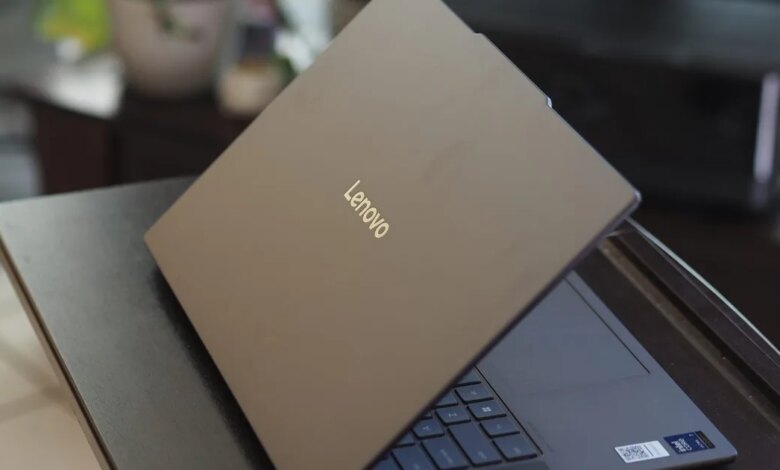
Alongside the compact desktop leak, details surrounding a new ultra-thin mobile PC have emerged under the moniker “ThinkBook Aeroblade.” The name, discovered within leaked marketing file structures, marks an entirely new brand designation within Lenovo’s commercial hardware line.
The physical images show a profile that challenges standard laptop dimensions. The outer edge of the chassis appears visibly thinner than the physical depth of a standard USB-C port. To accommodate necessary connectivity without compromising structural integrity or increasing overall thickness across the entire body, Lenovo appears to have engineered a small raised pod along the side frame. This dedicated module houses the USB-C ports and what appears to be an integrated microphone hole.
To support this level of slimness, the internal layout and external user interface have both undergone adjustments. The keyboard keycaps are noticeably flatter than those found on current ThinkBook models, pointing toward modified mechanical switches or reduced vertical key travel designed to eliminate excess millimetres inside the chassis assembly.
The pursuit of sub-10mm laptop design is not entirely unprecedented, but it remains rare due to thermal and structural constraints. The decade-old Acer Swift 7 previously set the benchmark for ultra-thin Windows laptops by measuring under 10 millimeters at its thinnest point. If official measurements confirm that the ThinkBook Aeroblade surpasses that mark upon release, Lenovo will have achieved a notable engineering milestone within the modern PC landscape.
Leaked Hardware Specifications and Feature Summary
The leaked imagery details two contrasting hardware directions: one prioritizing workstation port density within a reduced desktop footprint, and the other prioritizing maximum chassis reduction for mobile productivity.
| Hardware Attribute | ThinkCentre X Ultra | ThinkBook Aeroblade |
|---|---|---|
| Form Factor | Cube-shaped compact mini PC | Ultra-thin mobile notebook |
| Design Highlights | Front vent grille with built-in LED lighting | Chassis edge slimmer than standard USB-C port height |
| Port Integration | Front USB-C ports; rear Thunderbolt, HDMI, and DisplayPort | Dedicated raised pod housing external ports and microphone |
| Keyboard / Interface | Standard desktop peripherals (external) | Flatter keycap profile with reduced key depth |
| Hardware Speculation | Unconfirmed; rumored potential for Nvidia RTX Spark silicon | Unconfirmed processor and memory configurations |
| Market Positioning | Compact desktop workstation / Mac mini competitor | Ultra-portable enterprise laptop / thinness record contender |
Practical Implications and Unanswered Questions
The leaked designs reflect broader changes in how hardware manufacturers balance performance, cooling, and industrial aesthetics. For desktop users, the ThinkCentre X Ultra demonstrates that high-speed connectivity—such as dual Thunderbolt ports and multi-monitor output—does not necessarily require a traditional tower chassis. However, housing desktop-grade components within a tiny cube enclosure presents severe thermal challenges, raising questions about how Lenovo plans to handle sustained workloads and active cooling without excessive fan noise.
For mobile professionals, the ThinkBook Aeroblade highlights the ongoing compromise between visual elegance and practical usability. While an ultra-thin chassis dramatically improves portability, extreme spatial limitations often force trade-offs in battery capacity, thermal headroom, typing feel, and repairability. The inclusion of a raised pod for ports confirms that modern connector standards remain a physical bottleneck for laptop slimness, forcing structural adaptations when chassis design outpaces port dimensions.
Full technical specifications, thermal designs, pricing structures, and retail availability will remain unconfirmed until Lenovo officially presents the hardware at Lenovo Innovation World 2026 in September.