Restructuring Physical Identity: How Apple Wallet Redefines Privacy, Authentication, and Personal Data Control
For decades, physical identification cards have operated as static instruments of identity verification. A standard driver’s license or state-issued ID presents a comprehensive snapshot of personal data—displaying a full legal name, residential address, exact date of birth, physical attributes, and a unchangeable identification number on a single piece of plastic. Whenever an individual presents this card to verify their age at a venue, confirm identity at an airport, or assist an authority during a routine traffic stop, they inevitably expose every piece of printed information, regardless of whether the verifier actually requires it.
The integration of digital identification into Apple Wallet fundamentally alters this dynamic. By converting physical credentials into cryptographically secured digital artifacts, the technology introduces a granular, privacy-first approach to identity verification. Rather than relying on visual inspection of exposed plastic, digital IDs leverage localized hardware security, encrypted wireless protocols, and explicit biometric authorization to change how personal information is presented, transmitted, and protected.
Visual Privacy and Decoupled Credential Display
One of the primary vulnerabilities of a traditional physical ID is its complete lack of selective display. Anyone holding or looking at the card can read every line of printed text. Apple Wallet addresses this exposure by decoupling the initial visual card rendering from the underlying demographic data.
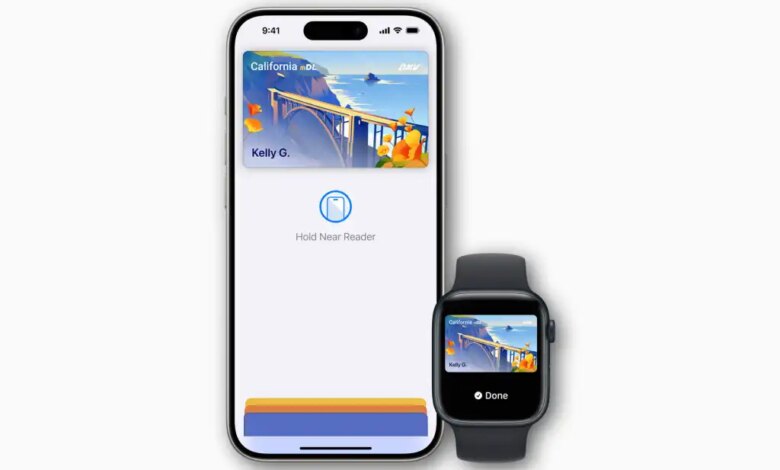
When an identity card is stored within Apple Wallet, the default on-screen display reveals minimal information, restricting visible text primarily to the cardholder’s name. Sensitive data fields—including home address, full date of birth, height, eye color, and unique driver’s license numbers—are isolated behind an additional layer of security. To inspect these attributes manually within the interface, the device mandates biometric authentication through Face ID or Touch ID. This architectural decision ensures that even if a device is active or viewed by third parties, private personal metrics remain locked within the system’s secure enclave.
The Technical Architecture: NFC, Bluetooth LE, and Barcode Elimination
Traditional digital identity concepts often rely on displaying dynamic QR codes or optical barcodes on screen for third-party scanners to read. However, static or dynamically generated barcodes remain vulnerable to unauthorized capture, screen photography, or unencrypted data caching by non-compliant readers. The implementation in Apple Wallet completely avoids optical scanning in favor of direct device-to-device wireless negotiation.
The transaction architecture functions through a two-phase connection process:
- Initial Proximity Discovery: Communication begins via Near Field Communication (NFC) when the iPhone is placed in close proximity to an authorized identity reader.
- Session Handoff: Once initial contact is established, the devices negotiate a secure, localized Bluetooth Low Energy (BLE) session to manage the actual payload exchange.
- Encrypted Payload Transfer: Data is transferred directly between the device and the reader over encrypted channels without relying on visual barcodes or unencrypted optical signals.
This approach eliminates the need for an external party to inspect an illuminated smartphone screen or scan a physical card, creating a closed-loop cryptographic exchange that limits interception risks.
Consent-Based Authorization and Minimal Data Disclosure
The user interaction model for presenting a digital ID closely mirrors the workflow of contactless mobile payments via Apple Pay. The process is strictly transactional and requires active user consent for every request.
When an iPhone comes into contact with a compliant identity reader—which may be a dedicated terminal or another enterprise-configured iPhone—the user’s device renders a dedicated system prompt. This prompt explicitly itemizes the specific data fields being requested by the verifier. For instance, an age-restricted request might specify that only confirmation of being over 21 is required, omitting the full birthdate, home address, and identification number entirely.
To finalize the transaction, the user must explicitly approve the release of information by double-clicking the side button and authenticating via Face ID or Touch ID. Data is never transmitted passively in the background; without explicit biometric authorization and intentional hardware interaction, no identity data leaves the device.
Eliminating Physical Custody in Official Interactions
A persistent concern surrounding digital credentials involves physical custody—specifically, whether presenting a smartphone to an authority figure, such as a law enforcement officer or TSA agent, requires handing over the physical device. Surrendering a smartphone introduces distinct privacy and legal risks, as an unlocked or handed-over phone could theoretically allow unauthorized access to messages, photos, financial apps, or personal records.
The technical structure of Apple Wallet IDs removes the operational necessity of surrendering physical control of the device. Because data transmission is handled entirely via localized NFC and Bluetooth LE connections, the iPhone remains firmly in the user’s hand throughout the entire verification sequence. Even if an officer or inspector were to hold the device, they would be unable to navigate through the phone’s contents or access hidden credential details without the user executing a real-time Face ID or Touch ID authentication prompt.
Comparing Physical and Digital Identity Verification
Understanding the operational shift between physical credentials and Apple Wallet digital IDs requires evaluating how basic identity functions are transformed by hardware security and encrypted transmission.
| Verification Dimension | Physical Identification Card | Digital ID in Apple Wallet |
|---|---|---|
| Data Exposure Control | All printed data (address, DOB, ID number) is fully exposed during every inspection. | Limits visual display by default; requires biometric authentication to view hidden fields. |
| Transmission Method | Visual inspection, magnetic stripe reading, or optical barcode scanning. | Encrypted NFC discovery followed by a secure Bluetooth Low Energy (BLE) session. |
| Device Physical Custody | Card must be physically handed over to the verifier or inspector. | User retains physical control of the iPhone at all times during wireless transfer. |
| Granular Data Sharing | All-or-nothing data sharing; full card is handed over regardless of verification scope. | Prompts user with exact fields requested, allowing minimal disclosure based on context. |
| Authentication Safeguards | No native hardware authentication; card can be used by anyone if lost or stolen. | Protected by device passcode and biometric gating (Face ID or Touch ID). |
Practical Implications, Operational Limits, and Broader Adoption
While digital identity frameworks offer clear advancements in personal data security, their broader practical significance depends on ecosystem integration and infrastructure readiness. The transition away from physical plastic cards is not instantaneous, and several key operational factors govern its trajectory.
First, digital ID acceptance requires compatible terminal infrastructure capable of supporting secure NFC and Bluetooth LE handoffs. Venues, law enforcement agencies, and government checkpoints must deploy certified readers capable of rendering verification requests and processing encrypted payloads. Second, users remain dependent on device power and operational state; a depleted battery or damaged hardware temporarily prevents credential presentation, necessitating a physical backup in many non-standard environments.
Nevertheless, the broader implication of digital credentials lies in establishing a privacy-centric baseline for personal identity. By moving away from unrestricted visual exposure and toward consent-based, cryptographically verified data sharing, digital IDs offer a robust framework for balancing regulatory authentication requirements with individual privacy rights.