Hugging Face Unveils the $399 MicroDuck Robot Featuring Lidar, NFC, and Roller Skates

Pollen Robotics Unveils Microduck, a $399 Open-Source Bipedal Robot Powered by Hugging Face
Pollen Robotics, an educational robotics company operating under the umbrella of artificial intelligence platform Hugging Face, has officially opened pre-orders for Microduck. Priced at an introductory figure of $399, the 25-centimeter-tall machine is designed as an open-source, bipedal platform built specifically to make reinforcement learning and physical AI experimentation accessible to developers, educators, and hobbyists. Deliveries are scheduled to begin in time for the Christmas holiday season.
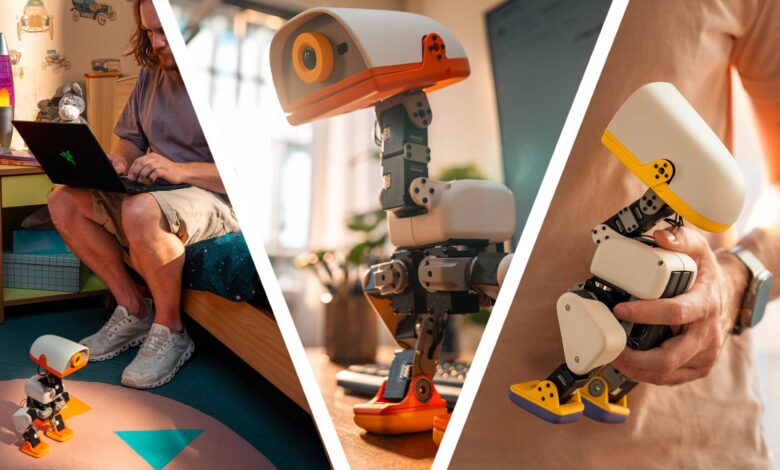
Microduck combines an expressive physical aesthetic with hardware capabilities engineered for dynamic balance, spatial awareness, and mobile manipulation. Weighing approximately 1.7 pounds, the robot features 15 degrees of freedom driven by 15 internal actuators. Its physical architecture is highlighted by a multifunctional mouth mechanism that doubles as an operational gripper, allowing it to interact physically with its surroundings rather than relying solely on visual or auditory responses.
Engineering a Compact Bipedal Platform
Achieving stable two-legged locomotion in small-scale robotics presents significant mechanical and computational challenges. Microduck addresses dynamic stabilization through a dual Inertial Measurement Unit (IMU) array. These sensors monitor orientation and acceleration in real time, enabling the machine to maintain balance while walking or waddling across surfaces. The system is also engineered with self-righting routines, allowing the robot to detect when it has tipped over or been pushed, adjust its internal joints, and stand back up autonomously.
To navigate physical spaces, Microduck integrates a multi-modal perception system. A Lidar scanner works alongside a single-eye camera to map local environments, identify obstacles, and recognize objects or human users. The sensory framework is complemented by onboard microphones for auditory processing and built-in speakers capable of producing custom audio outputs and duck-inspired vocalizations. Wireless connectivity is maintained through integrated Wi-Fi, Bluetooth, and Near Field Communication (NFC) modules.
Processing duties are handled by a low-power Rockchip RK3566 ARM processor, supported by 1GB of RAM and 32GB of onboard storage. Power is supplied by an internal 2,600mAh battery, which delivers approximately one hour of continuous operation per charge. The combination of lightweight processing hardware and specialized sensor integration reflects an engineering design focused on balancing cost, mobility, and onboard control.
Reinforcement Learning and the Sim-to-Real Workflow
While Microduck ships with a suite of pre-programmed behaviors and can be manually operated using a standard gaming controller, its primary focus is acting as a development bed for reinforcement learning (RL). Pollen Robotics describes the platform as an entry point for embodied AI, providing developers with tools to train custom neural networks for physical control.
The software ecosystem relies on an open-source model supported by a software development kit (SDK). This kit provides virtual simulation environments, pre-configured training scripts, and a validated sim-to-real workflow. Under this framework, users can train motor control algorithms, movement policies, and navigation models inside a simulated physics environment on a standard computer. Once the virtual model achieves desired behaviors, the learned control weights are deployed directly to Microduck’s physical hardware.
This workflow minimizes physical wear on the robot’s 15 actuators during initial learning stages, where random trial-and-error movements could otherwise cause mechanical strain or falls. The open-source architecture also allows users to write custom scripts to process inputs from the camera, Lidar, and NFC reader, turning low-level sensor data into high-level autonomous routines.
Hardware Packages and Ecosystem Options
Pollen Robotics offers Microduck in four color finishes: Cream, Graphite, Lavender, and Sky. Alongside the base robot, the company has announced several optional hardware bundles designed for expanded development and maintenance needs.
| Package Option | Included Components & Features | Pricing |
|---|---|---|
| Microduck Base Package | 25 cm bipedal robot, 15 actuators, Lidar, camera, dual IMUs, RK3566 processor, 1GB RAM, 32GB storage, 2,600mAh battery | $399 (Introductory) |
| Dev Pack | Replacement servo motors, spare cabling, and additional battery units | $119 |
| Accessory Pack | Wearable mini roller skates, a targeted laser pointer, and 10 programmable NFC tags | Not specified |
| Charger Pack | Dedicated power supply and charging station hardware | $39 |
The accessory options highlight both practical maintenance and potential programming exercises. The inclusion of 10 programmable NFC tags enables developers to set up physical triggers within an environment; for instance, programming the robot to perform specific actions or directional turns when its internal NFC scanner reads a tag placed on a surface. Similarly, the wearable roller skates provide a specialized testing platform for complex locomotion algorithms that adapt to wheeled balance rather than standard walking steps.
Evolution from Desktop Companions to Mobile Robotics
Microduck represents a notable strategic shift for Pollen Robotics. The company’s previous release, the Reach Mini, was a stationary desk companion focused on static interactions and desktop utility. Pollen Robotics reported selling approximately 10,000 units of the Reach Mini platform. Microduck expands on that baseline by transitioning from a fixed spatial footprint to dynamic, untethered locomotion.
The visual design choices draw clear comparisons to high-end research and entertainment platforms, such as the semi-autonomous BDX Droids developed by Disney for theme park deployments. Both platforms utilize a squat, bipedal posture, oversized head geometry, and expressive joint movements to create approachable human-robot interactions. However, while enterprise entertainment droids rely on custom industrial components, proprietary software, and high production budgets restricted to theme park environments, Microduck is structured specifically as a low-cost, commercially available consumer device with entirely open-source software access.
Practical Implications, Constraints, and Outlook
The introduction of a $399 bipedal platform highlights both the progress and the current constraints of consumer-grade embodied AI hardware. The inclusion of Lidar, 15 articulated joints, dual IMUs, and open-source reinforcement learning workflows at this price point demonstrates how lower component costs are lowering barriers for robotics education.
At the same time, the hardware specifications outline key operational boundaries. A runtime of approximately one hour from the 2,600mAh battery means that extended development sessions will require frequent recharging cycles or spare batteries from the optional Dev Pack. Additionally, while the compute hardware (1GB RAM paired with an RK3566 processor) is sufficient for local sensor interpretation and executing pre-trained inference models, intensive AI model training must be offloaded to external computers before deploying the resulting policies back to the machine.
The long-term utility of Microduck will depend heavily on community engagement around its open-source repository. If developers actively contribute pre-built control models, custom simulation environments, and interactive software modules, the platform could become a primary hardware choice for entry-level robotics instruction. With pre-orders open and shipping planned before the end of the year, Pollen Robotics is positioning the platform as an accessible testbed for bridging the gap between digital AI models and physical environment interaction.